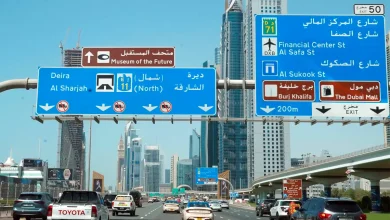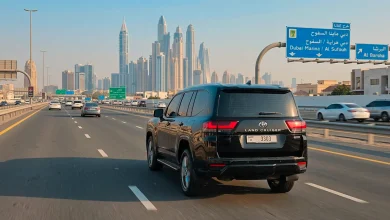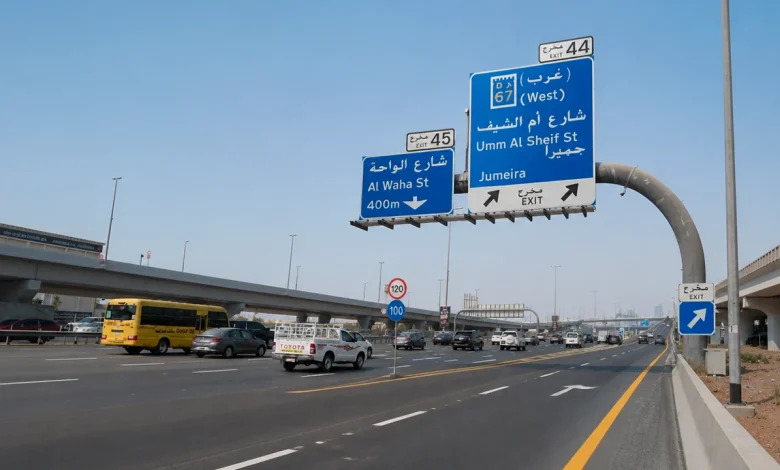
If you are going to get into your private or rented car in the next few hours and hit the road using a navigation app and following their suggested speed limit, I must tell you that you should expect fines of several hundred dirhams from now on. Because the suggested speed of the apps is not always the same as the actual speed on the sign, and even the maximum speed is not the same for all Emirates. But don’t worry, in this post from Saadatrent, we will review speed limits in UAE and share our experience with the rules, mistakes, and fines of our previous customers.
UAE speed limits: quick answer
If you’re going to be driving for a few more minutes and you’re in a hurry, let’s quickly summarize the speed limits in the UAE.
- In cities: usually between 40 and 80 km/h
- Main roads: between 60 and 100 km/h
- Motorways: between 100 and 140 km/h
- On some highways: up to 160 km/h (the highest speed limit in uae)
But here’s the thing: the number you see on the roadside sign always has the final say, not what you have in your head or what you see on the map on your phone. Let’s go over all these details together.
Planning to Drive in Dubai? Find the Right Rental Car
Explore cars for your Dubai trip with flexible rental options, convenient delivery and 24/7 support from Saadat Rent.
How speed limits work in the UAE
The UAE police use a smart network of cameras, artificial intelligence and variable electronic signs to manage traffic. The biggest difference to consider when driving in the UAE is how the cameras calculate speed:
20km/h buffer vs actual speed
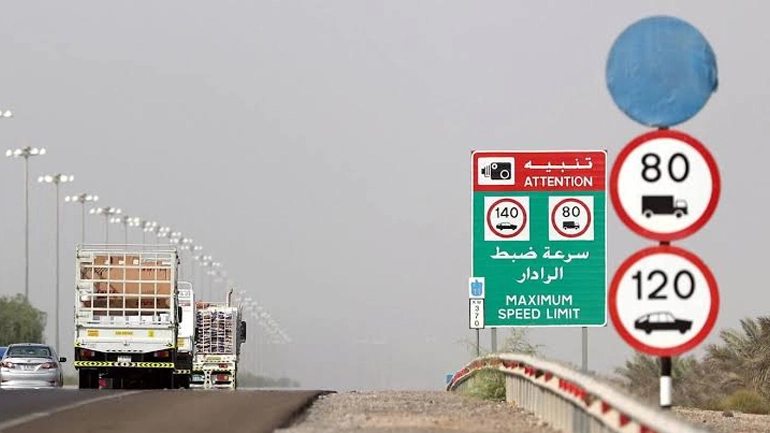
In most of the Emirates, there is a speed buffer. This means that if the sign says 80km/h, you usually won’t be fined for going 20km/h over that limit (i.e. up to 100km/h). This rule is common in Dubai, Sharjah and most other emirates, but Abu Dhabi is an exception. So if you’re traveling to different emirates, it’s best not to rely on the buffer.
Radar Threshold
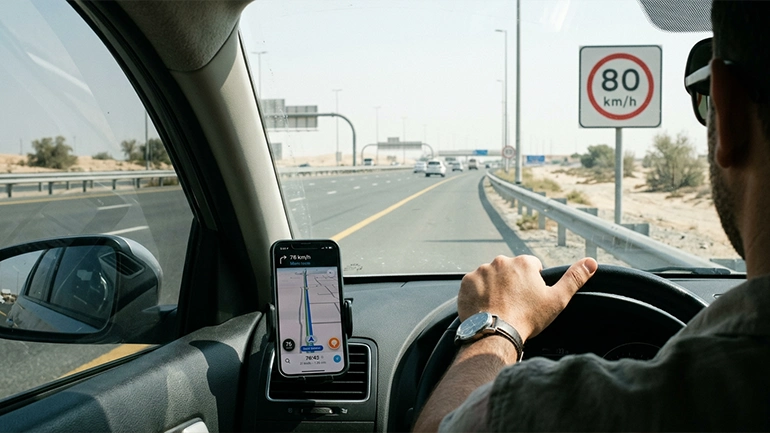
Another thing to know is that Dubai Police publishes two separate numbers in their official database: “road speed” and “radar speed.” The two aren’t always the same, so it’s best to always trust the sign posted on the road at that moment, not the number you see in your navigation app. The speed limit can change depending on the section of road, direction of travel, weather conditions, and even the time of day.
Dubai speed limits
The RTA is constantly updating the speed limits on highways. However, we have tried to show you the general speed limits in Dubai UAE in the table below.
| Road Type / Area | Posted Speed Limit (km/h) | Max Speed with Buffer (km/h) | Key Notes |
| Residential Streets & Inner Neighborhoods | 25 – 40 | 45 – 60 | Pedestrian-heavy areas; strictly follow posted signs |
| School Zones & Educational Areas | 30 – 40 | 50 – 60 | Very strict camera enforcement |
| Secondary & Single-Lane Urban Roads | 50 – 60 | 70 – 80 | Local and inter-neighborhood routes |
| Main Urban Roads (e.g., Jumeirah Rd, Al Wasl Rd) | 70 – 80 | 90 – 100 | High-traffic city roads |
| Primary Urban Highways (e.g., Sheikh Zayed Rd E11, Al Khail Rd E44) | 100 | 120 | Major city arteries; reduce speed in rain |
| High-Speed Peripheral Highways (e.g., Sheikh Mohammed bin Zayed Rd E311) | 110 | 130 | Busy inter-emirate routes with multiple lanes |
| Intercity & Desert Highways (e.g., Emirates Rd E611, Dubai–Al Ain Rd) | 120 | 140 | Highest legal speeds in Dubai emirate |
| Construction & Roadwork Zones | 60 – 80 (yellow signs) | 80 – 100 | Temporary yellow/digital signs take priority |
As we said, a 20 km/h buffer is usually enforced in Dubai, but never consider this as an official maximum speed limit in the UAE; it’s just a technical fringe of the camera system, not a rule you can count on.
Abu Dhabi speed limits
Since 2018, Abu Dhabi Police have completely abolished the speed limit (Buffer) law. So if you are going to have a car rental in Abu Dhabi, you should know that a 120 km/h sign means the maximum speed is exactly 120. In addition, Abu Dhabi has implemented some important changes to the speed limit on its roads in 2026, including the removal of the minimum speed law to increase driver safety and reducing the maximum speed on some intercity and suburban routes.
| Road Type / Area | Posted Speed (km/h) | Key Note (2026 Update) |
| Residential Areas | 25 – 40 | No buffer; even 1 km/h over can result in a fine |
| School Zones | 30 – 40 | Smart monitoring and strict enforcement |
| Main Urban Roads | 60 – 80 | Variable limits in high-traffic areas |
| Urban Highways | 80 – 120 | Zero buffer; posted signs strictly enforced |
| Intercity Highways (General) | 100 – 140 | Some routes had reduced limits in 2026 |
| E22 (Abu Dhabi – Al Ain) | 120 – 140 | Previously 160; reduced in 2026 |
| E20 (Abu Dhabi – Sweihan) | 100 | Reduced from 120 to 100 for safety |
| E311 (Sheikh Mohammed Bin Rashid Road) | Variable (approx. 110–140) | Minimum speed requirement of 120 removed |
| Left Lanes (Highways) | As per posted signs | No longer a mandatory 120 minimum; avoid lane hogging |
Many of the amendments you see in the table were made even before 2018 and are often referred to as new speed limits in UAE 2016.
Sharjah, Ajman, RAK, Fujairah and Umm Al Quwain
In this emirate, the general rules are similar to the driving rules in Dubai, but always keep one principle in mind: the sign on any road is the rule of that road.
| Emirate | Buffer Rule | Maximum Highway Speed |
| Sharjah | +20 km/h | 120 (effective limit: 140) |
| Ajman | +20 km/h | 120 (effective limit: 140) |
| Ras Al Khaimah (RAK) | +20 km/h | 120 to 130 (on some roads) |
| Fujairah | +20 km/h | 100 to 120 |
| Umm Al Quwain (UAQ) | +20 km/h | 120 (effective limit: 140) |
On the mountainous roads of Ras Al Khaimah and Fujairah (such as the Jebel Jais Road), there are sharp bends and the speed limit is reduced to 40 to 60 km/h.
Speed limits by road type
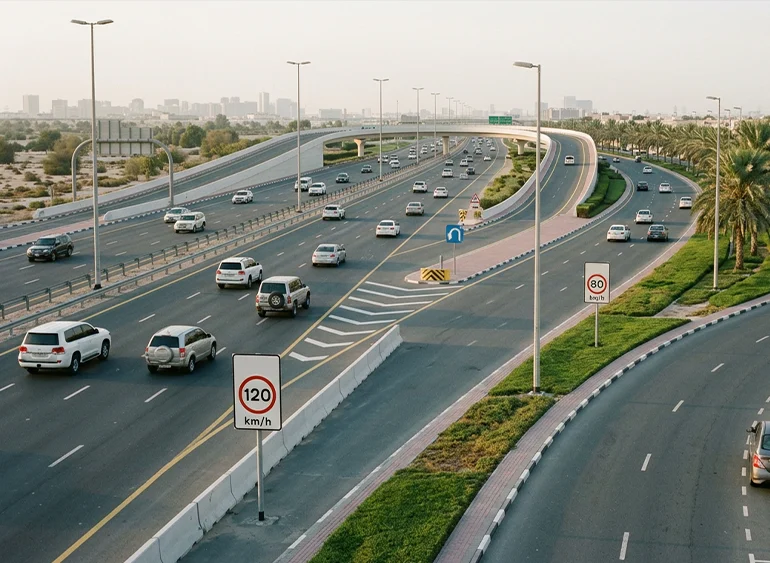
If you have paid attention, in the previous sections you can see the speed limit based on the type of road, however, let’s take a look at the road speed limits in the UAE once again in a simpler way.
| Road Type / Area | Posted Speed (km/h) | Approx. Camera Threshold in Dubai | Status in Abu Dhabi (2026 Update) |
| Residential Areas | 25 – 40 | Usually close to posted speed (sometimes no buffer) | No buffer; fined from 1 km/h above |
| School Zones | 30 – 40 | Effectively no buffer | No buffer + strict enforcement |
| Urban Roads | 60 – 80 | About 10–20 km/h higher (depending on road) | No buffer; posted speed strictly enforced |
| Urban Highways (e.g., E11) | 100 – 120 | Up to ~20 km/h higher on some roads | No buffer; 100–120 strictly enforced |
| Intercity Highways | 120 – 140 | Up to ~20 km/h higher on some roads | No buffer; usually capped at 140 |
| E22 (Abu Dhabi–Al Ain) | 120 – 140 | — | Reduced from 160 to 140 (some sections 120) |
| E20 (Abu Dhabi–Sweihan) | 100 | — | Reduced from 120 to 100 |
| E311 (Abu Dhabi) | Variable (approx. 110–140) | — | Minimum speed requirement of 120 removed |
Speeding fines and black
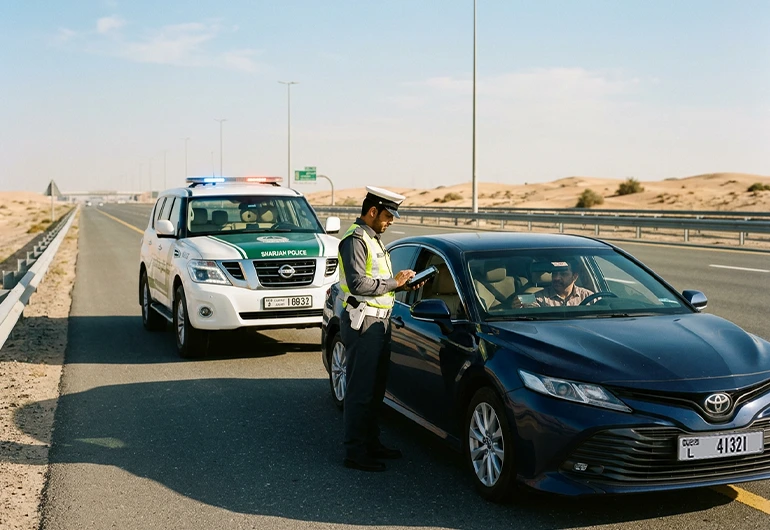
Now, let’s get to the part that no driver wants to deal with, but it’s in your best interest to know. UAE traffic fines are graded, meaning the faster you go over the speed limit, the heavier the fine.
| Speed Violation Range | Fine Amount (AED) | Black Points | Vehicle Impound Duration |
| Up to 20 km/h over the limit | 300 AED | None | None |
| 21 to 30 km/h over | 600 AED | 4 points (in some emirates) | None |
| 31 to 40 km/h over | 700 AED | 6 points | None |
| 41 to 50 km/h over | 1,000 AED | 6–8 points | None |
| 51 to 60 km/h over | 1,500 AED | 6–12 points | 15 days |
| 61 to 80 km/h over | 2,000 AED | 12 points | 30 days |
| More than 80 km/h over | 3,000 AED | 23 points | 60 days |
Abu Dhabi Fine Discount Tip: If you pay your Abu Dhabi traffic fines within 60 days of registration, Abu Dhabi Police will automatically apply a 35% discount on most violations!
Black points explained
Black points are also a story in themselves. If you accumulate 24 points in a year, your license will be suspended for a period of time; the first time for three months, the second for six months, and the third for up to a year, with the requirement to retake the driving test. These points are attached to your license, not the car, so if you drive a rental car, they will still be on your personal file.
Another important note: Since the rules and fine amounts change from time to time, it is best to always check the latest status of your fines via the Dubai Police app, the RTA portal, or the TAMM system in Abu Dhabi.
Rental-car driver tips
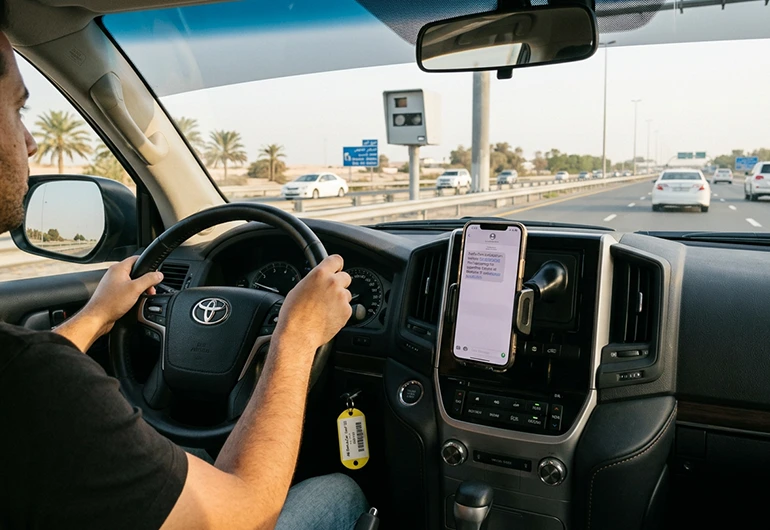
If you have rented a car in the UAE or are planning to rent one, be sure to keep these things in mind:
1. Instant registration and payment of fines from the deposit
UAE radars record the violation instantly. The fine SMS is sent immediately to the car owner (rental company) and they deduct this amount from the deposit amount or your credit card.
2. Rental company administrative fee (Admin Fee): In addition to the principal amount of the fine, most companies charge about 10% to 20% (or a fixed amount of 50 dirhams) plus 5% Value Added Tax (VAT) as an administrative fee on each fine.
3. Deposit return period (21 to 30 days)
Car rental companies usually keep your deposit for between 21 and 30 days after you return the car. This is because some intercity fines or road tolls may be registered in the police system with a delay of a few days.
4. Road toll system (Salik in Dubai and Darb in Abu Dhabi)
Every time you pass through the Salik gates in Dubai, 5 dirhams will be credited to your account as Salik charges in Dubai. There is no Salik system in Abu Dhabi and instead, the Abu Dhabi Darb system is active during peak traffic hours (7am to 9am and 5pm to 7pm).
5. Smart use of cruise control:
The best tool to avoid fines on long highways is to set cruise control. Just be sure to set it to the buffer number in Dubai (for example, 119 on Route 100) and to the exact number on the sign in Abu Dhabi.
6. Speed warning and car tracker (Speed Beeper)
Most rental cars in the UAE, by law, beep when they exceed 120 km/h. Some companies also have GPS tracking systems and report accident-causing speeds directly to you or the police.
7. Heavy Smart Impound Fines:
If you speed and are subject to a car impound order (for example, driving over 50 km over the limit), you will have to pay the rental company a “smart impound” fee or daily parking fee (sometimes 100-300 dirhams per day).
8. Police Report for the smallest damage:
If you have an accident due to speeding or sudden braking, you must get a police report (green or red sheet) through the Dubai Police (in Dubai) or Saaed (in Abu Dhabi) app. Without this report, the insurance will not cover any damage and the rental company will charge you the entire cost.
“`htmlReady to Drive? Choose Your Car.
Know the speed limits. Pick the right car. Start your UAE trip with Saadat Rent.
Browse Saadatrent Cars →Common mistakes in UAE Speed Limits
We always remind our customers at Saadatrent who plan a car rental in Dubai or any other emirate about several common mistakes, including:
- Thinking that 20 is always allowed: This is the biggest trap. This number is not fixed in Dubai and does not exist in Abu Dhabi. Many people get fined precisely because of this wrong assumption.
- Not paying attention to sudden changes in signs: In the UAE, it is very common for the speed to suddenly drop from 120 to 80, for example near exits or construction zones. If you are not careful, you will get a fine right there.
- Trusting Google Maps or GPS completely: Maps are not always up-to-date. They may show the speed incorrectly or not have the latest changes. The road signs always have priority.
- Driving at high speed in the wrong lane: The left lane is only for overtaking. If you stay in it at high speed but do not overtake, you will both get a fine and create a danger.
- Tailgating: Many people think that only speed matters, but getting too close to the car in front can also result in a hefty fine, even if you are within the speed limit.
- Ignoring Construction Zones: In construction zones, speeds are usually lower and there is more enforcement. These signs are temporary, but the fines are very real.
- Assuming the rules are the same in all emirates: If you are used to driving in Dubai and continue the same style in Abu Dhabi, your chances of getting a fine will increase.
Conclusion
Driving a modern car on UAE roads can be an enjoyable experience as long as you follow the driving laws, especially the speed limits in UAE. As a final piece of advice, we would like to tell you to always trust the road signs, not your memory or the suggestions of navigation apps. This will save you from fines and negative points, and more importantly, your journey on UAE roads will be safer and more relaxed.
FAQ
1. Do speed cameras in the UAE only monitor speed?
No. Many cameras also record violations such as running red lights, not maintaining a safe distance, changing lanes suddenly and even using a mobile phone.
2. Are speeding tickets different for rental cars?
No. The fine amount is the same, but the payment process is different; the fine is first registered with the rental company and then collected from you, along with an administrative fee.
3. How can I find out about the fines I have received?
You can check the status of your fines via the police website of each emirate, official apps such as MOI UAE, or the car rental company’s notification.
4. Do speed limits change at night or during off-peak hours?
No, but in certain areas or road projects, the limits may change temporarily; always pay attention to the digital signs.
5. What to do if there are no speed signs?
In this situation, you should use the general limits of any type of road (e.g., city or highway), but it is best to drive carefully until you see the first sign.