- UAE Traffic Signs at a Glance table
- Regulatory Signs
- Warning Signs and Hazard Markers
- Guide, Direction and Information Signs
- Know the Signs. Choose Your Car.
- Road Markings, Traffic Lights and Lane-Control Signals
- Temporary, Construction and Weather Signs
- Using Signs Safely in a Rental Car: Mirrors, Lane Changes, Navigation & Speed Limits
- Quick Knowledge Check
- Final words
- FAQ
Traffic signs in UAE are divided into four main categories. Round signs with a red border usually give instructions or prohibitions, yellow or red triangular signs warn of danger, blue or green rectangular signs show directions and directions, and orange temporary signs are related to construction or weather conditions. If you keep these four colors and shapes in mind, you won’t get lost on most roads in the UAE. However, we recommend that you read on to learn more about UAE traffic signs.
UAE Traffic Signs at a Glance table
Basic traffic signs UAE are usually classified into these functional categories, and each group has a specific shape and color and requires a different action from the driver:
| Sign Category | Shape & Colour | Purpose | Driver Action | Examples |
|---|---|---|---|---|
| Regulatory | Red/blue, circular | Rules & restrictions | Follow the sign | Speed limit, No entry |
| Warning | Red triangle | Warn of hazards | Slow down, stay alert | Sharp curve, Speed bump |
| Guide & Information | Green/blue/brown, rectangular | Directions & destinations | Choose lane/route | Exit, Airport |
| Temporary & Construction | Yellow/orange | Temporary road changes | Follow these signs first | Detour, Lane reduction |
| Road Markings | White/yellow lines | Control lane movement | Follow line rules | Solid, Broken line |
| Lane Control Signals | Arrows, overhead lights | Lane status | Use permitted lanes | Green arrow, Red X |
| Parking Control | Blue/white | Parking rules | Park as permitted | Paid, Reserved parking |
Regulatory Signs
Command signs are those that tell you what to do or what not to do. Ignoring these signs will result in a fine and a negative driving record.
Control Signs
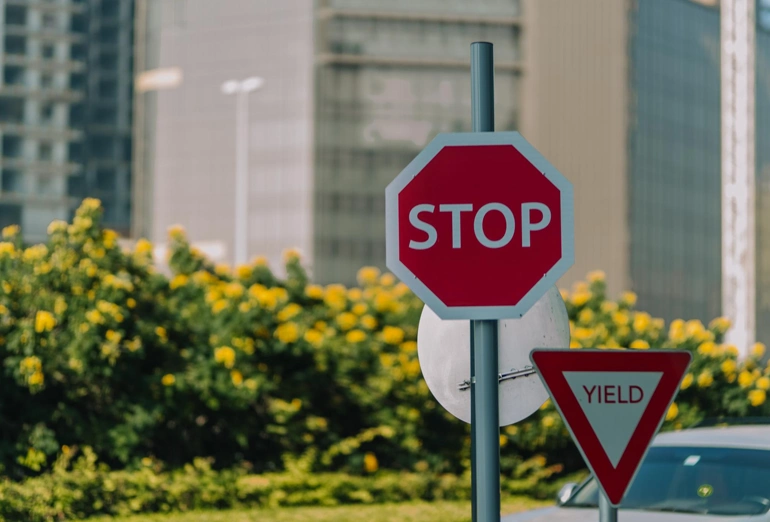
You will often see the red octagonal “Stop” sign and the inverted triangular “Give Way” sign at intersections and highway entrances.
Driver Action Required: Stop completely before the stop line and only move when you are sure the road is clear; at the give way sign, you must also slow down and yield to the main traffic.
Mandatory Signs
These are circular signs with a blue background and white markings. They indicate the path you are legally required to take. Common examples include “Right Turn Required,” “Go Straight Only,” or “Minimum Speed Limit.”
Driver Action Required: Follow the direction indicated by the sign exactly and do not change direction in the opposite direction of the sign.
Prohibitory Signs
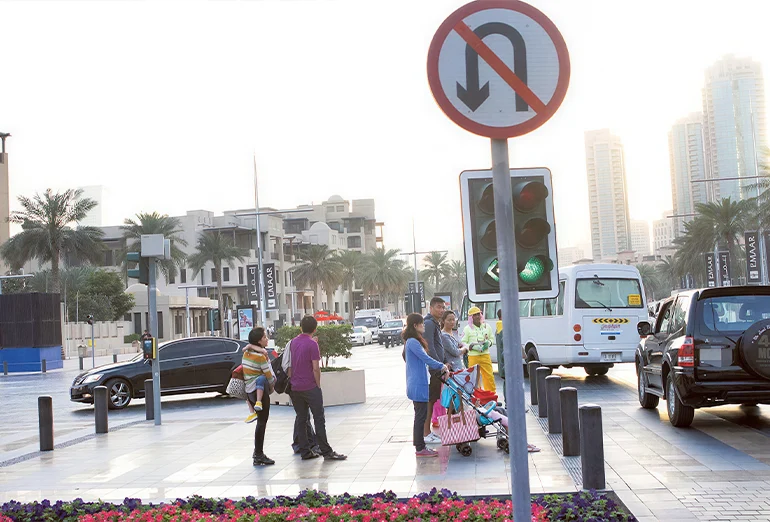
Circular signs with a red border and a white background, some of which have a red line drawn on them, prohibit a specific action. Such as “No Overtaking”, “No U-Turn”, “Maximum Speed Limit” and “No Entry”.
Driver Action Required: Do not perform the action specified on the sign under any circumstances to avoid fines and risking your life.
Parking-Control Signs
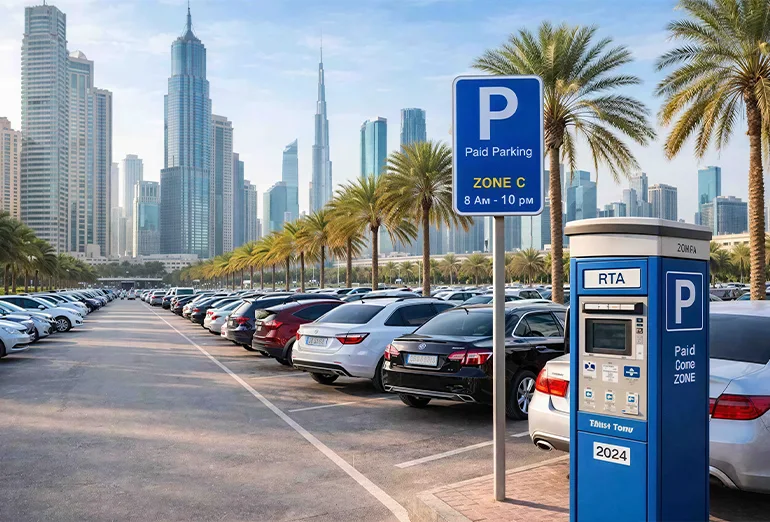
These signs indicate how, when and under what conditions parking vehicles on the streets is allowed. Blue signs marked with the letter P indicate RTA (Dubai Transport Authority) paid zones.
Driver’s mandatory action: Before leaving the car, check the parking zone code and pay the fee via SMS, app or parking meter. As mentioned, failure to comply with any of these items will result in heavy fines, sometimes reaching several thousand dirhams. To understand how heavy this is, we suggest you read the UAE traffic fines post.
Warning Signs and Hazard Markers
UAE warning signs are mostly triangular with a red border. The purpose of this category of traffic signs UAE is to give you enough time to slow down your rental car and prepare for changing road conditions.
Curves
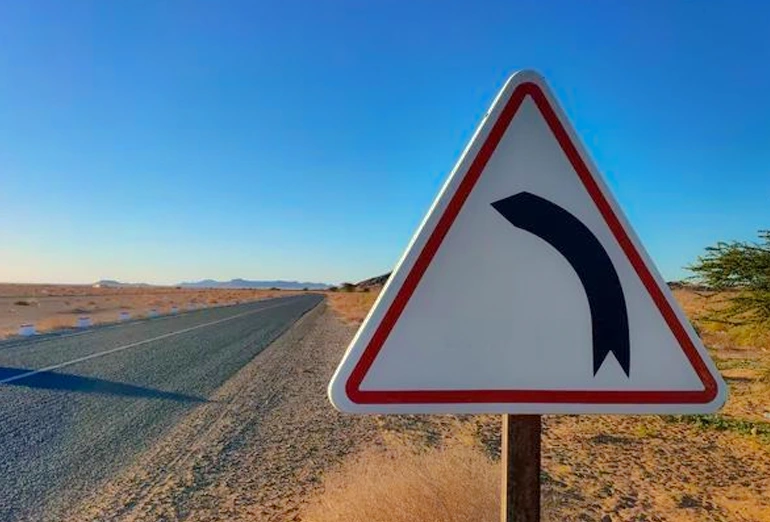
These signs indicate sharp right or left turns, as well as consecutive turns. Before entering a curve, slow down and keep your foot on the accelerator to maintain control of the vehicle.
Merges
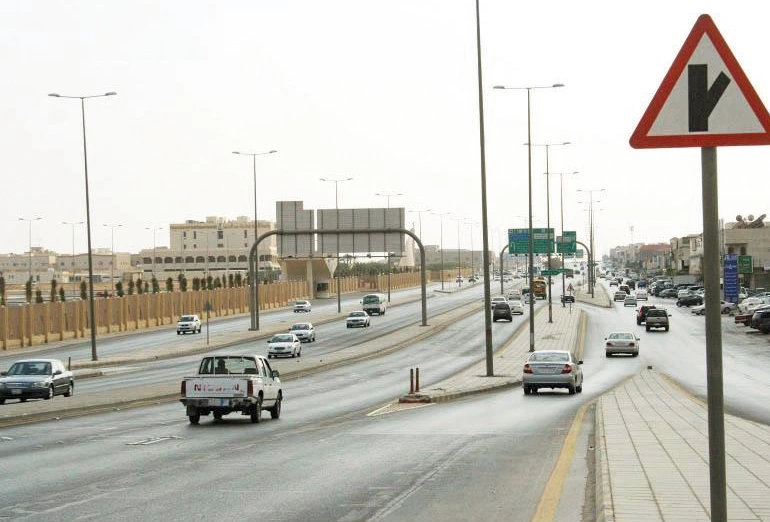
Indicates the addition of new lanes to the main road or the reduction in the number of lanes. Check your mirrors, signal, and merge with the main road at a reasonable speed.
Roundabouts
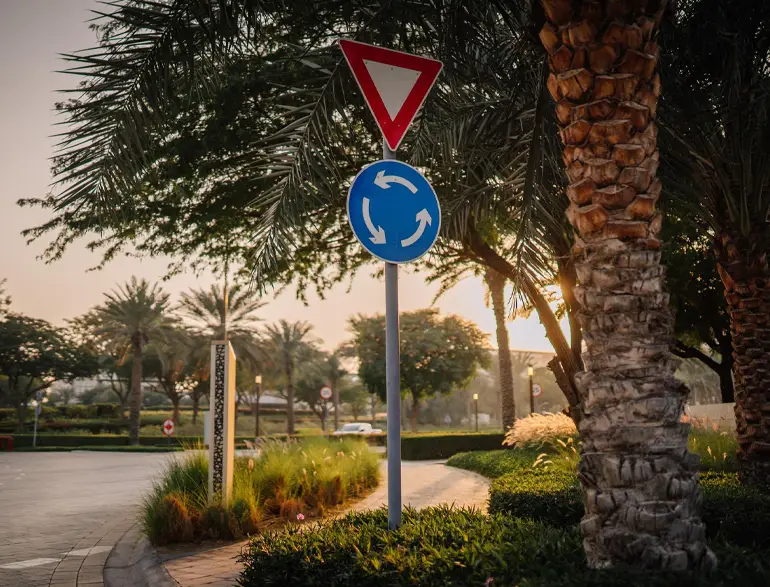
Roundabouts are very common in the UAE, especially in residential areas and smaller cities like Sharjah. The right of way always goes to the vehicles that are already inside the roundabout. Stop completely or slow down before entering.
Crossings
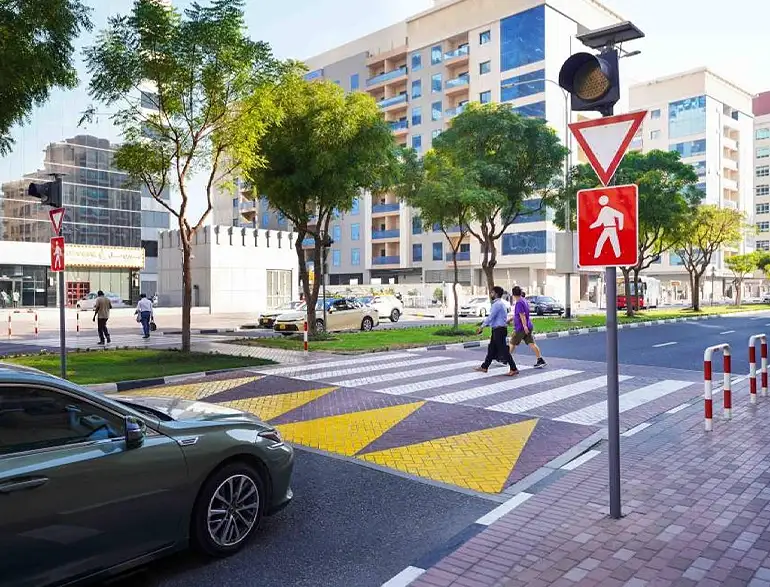
Indicates that you are approaching a pedestrian crossing or intersection without traffic lights. Reduce your speed and be prepared to come to a complete stop for pedestrians.
Speed Humps
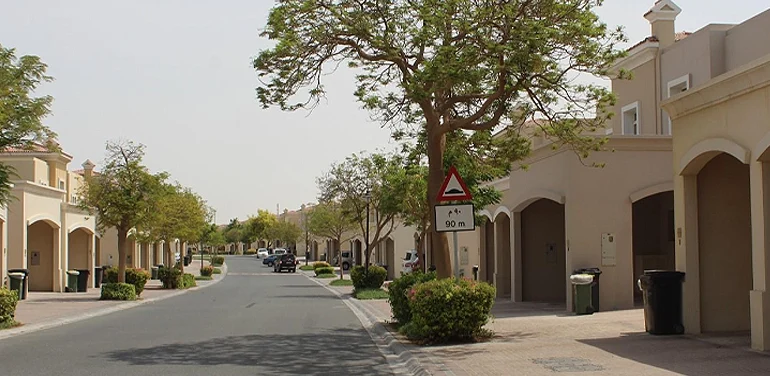
There are standard speed humps on secondary streets and residential areas in Dubai, which are announced with this sign. Brake to avoid damaging the front of your rental car; speeding over them is also subject to a fine.
Animal Crossings
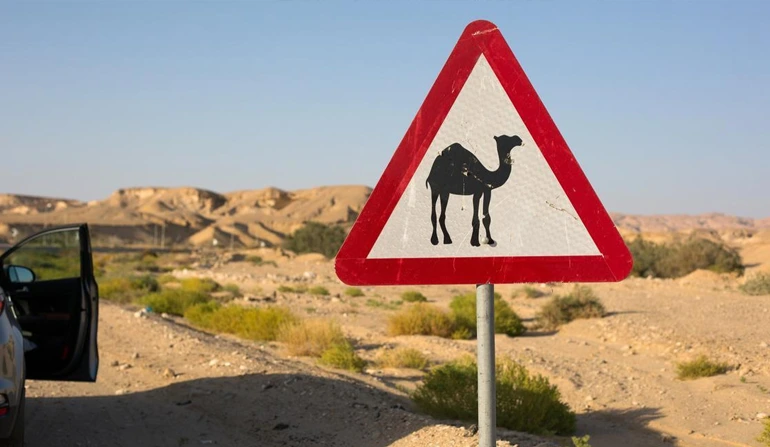
You will often see signs with the image of a camel or deer on intercity highways and desert roads. Be extra vigilant at night; camels are large and can be fatal.
Rocks & Inclines
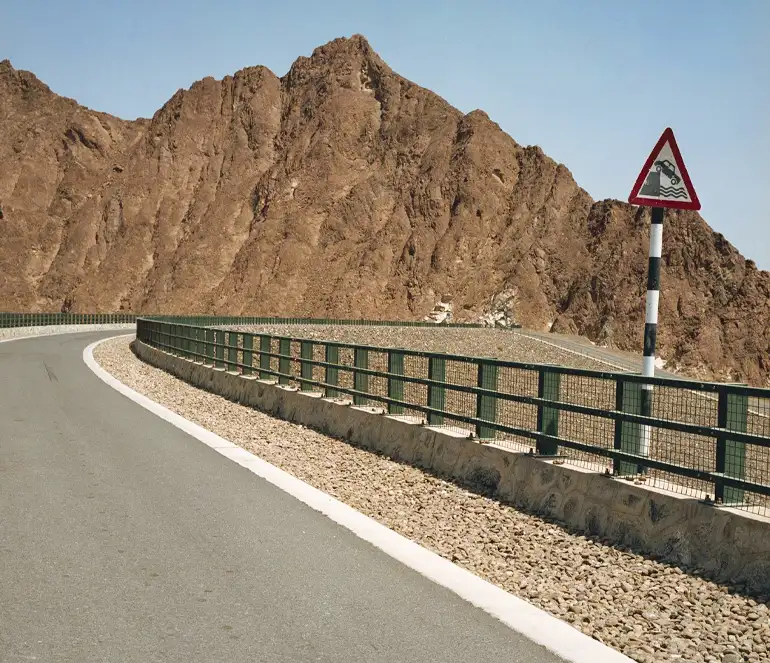
Mostly seen in mountainous areas such as Hatta or Ras Al Khaimah. Avoid stopping under rocks and drive in the appropriate gear on slopes.
General Hazards
A sign with an exclamation mark (!) warns of unexpected hazards on the road. Concentrate fully on driving and increase the distance between you and the vehicle in front.
Guide, Direction and Information Signs
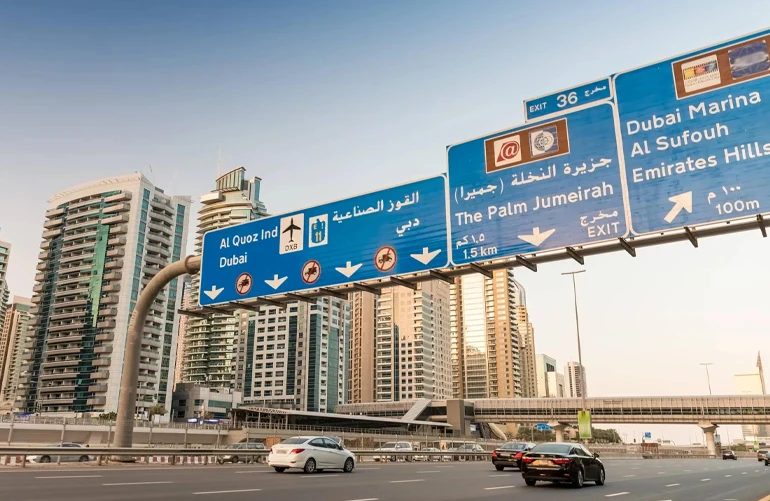
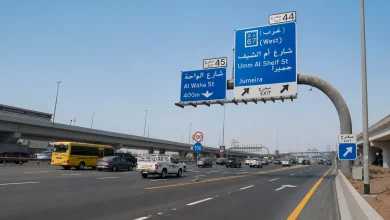
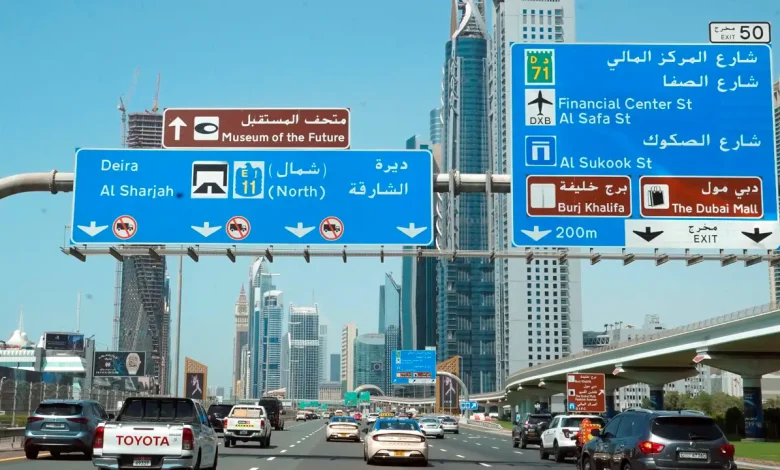
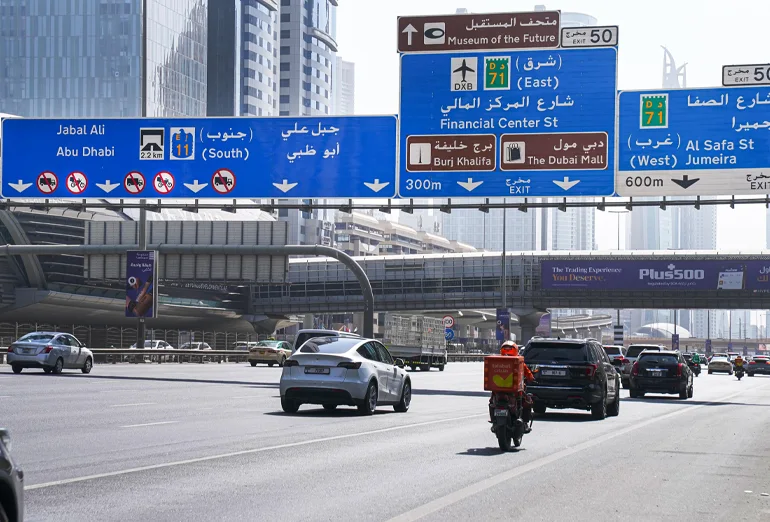
The UAE’s road system is based entirely on colour coding and numbering of exits. Knowing how to read traffic signs in the UAE will make driving a breeze.
Highway Exits and Ramps
All exits on UAE highways are numbered. Warning signs will let you know the exit number a few kilometres in advance. If you are about to exit, move to the rightmost lane at least 500 metres before you reach the ramp.
Route Colours
These signs indicate locations, exits and intercity routes, and their colours provide more information:
- Blue signs: indicate routes, streets and destinations within Dubai (Local Routes).
- Green signs: Major intercity highways and expressways (E-Routes such as the E11 or Sheikh Zayed Road) that connect different emirates.
- Brown signs: Direct you to tourist attractions, historical sites, parks, and prominent hotels.
- White signs: Indicate side streets, specific neighborhoods, or local road names.
Color conventions can vary slightly between emirates, so it’s best to check with official sources such as Dubai’s Roads and Transport Authority (RTA) to be completely sure.
Airports & Hospitals
A white airplane symbol on a blue or green background identifies airports. A red crescent symbol or the letter H directs you to hospitals and emergency centers.
Tourism Signs
These brown signs will help you find the water parks, Burj Khalifa, Jumeirah Beach, and the Future Museum without the need for a map.
Bilingual Navigation
All geographical names are first written in Arabic script, followed by an accurate English transcription, so that international tourists can navigate without any problems.
Know the Signs. Choose Your Car.
Ready to drive in Dubai? Find the rental option that fits your trip.
Road Markings, Traffic Lights and Lane-Control Signals
Road markings in the UAE are considered vertical road signs and are mandatory.
Solid vs. Broken Lines
A broken white line means that overtaking or changing lanes is permitted, provided that caution is exercised; a solid white or yellow line means that changing lanes or overtaking is strictly prohibited at that point. If a solid line and a broken line are next to each other, the rule applies to the lane you are driving in.
Stop Lines
A wide white line before an intersection or traffic light is the exact point where you must stop completely, no further ahead or behind.
Box Junctions / Yellow Grids
Crossed yellow lines on the road indicate that you are only allowed to enter this area if you are sure you can pass it without stopping; otherwise, you must wait behind the line. Getting stuck on these lines when the light is red can result in a hefty fine.
Pavement Arrows
White arrows on the pavement indicate the permitted direction of travel in each lane. If your lane has a right-turn arrow, you must turn right at the intersection.
Pedestrian Crossings
Parallel white lines are official pedestrian crossings. By law, you must stop before these lines and let pedestrians cross.
Flashing Signals & Lane-Control
A flashing yellow light means caution and gives way. Lights above the traffic lanes (red cross or green arrow) indicate whether a lane is open or closed on highways.
Temporary, Construction and Weather Signs
The UAE, especially Dubai, is always under construction, so you will see a lot of temporary orange signs, which is why they are so important in the UAE traffic signs list.
The main rule: Temporary construction site instructions and signs always take precedence over permanent road signs and markings, and you must obey them completely.
That is, if an orange sign indicates a speed limit or a detour, you must follow it, even if it differs from your map or route plan. The same rule applies in rainy or dusty conditions; take temporary signs warning of “reduced visibility” or “slippery surface” seriously, as in such conditions, the roads in the UAE can become unexpectedly dangerous.
12 UAE Signs Tourists Commonly Misread Table: sign, mistaken interpretation, correct meaning, safe action.
In our customer support experience at Saadatrent AE, these are the things that confuse them the most, so it’s a good idea for you to familiarize yourself with them.
| Sign | Common Misinterpretation | Correct Meaning | Safe Action |
|---|---|---|---|
| Yellow Box Junction | You can wait inside | Do not stop inside the box | Enter only if the exit is clear |
| Tram Priority | Trams have equal priority | Trams have priority | Stop and let the tram pass |
| Minimum Speed Limit | It shows the maximum speed | Shows the minimum speed | Maintain the minimum or move right |
| Bus & Taxi Lane | Everyone can use it in traffic | Reserved for public transport | Do not enter |
| Chevron Markers | Decorative signs | Sharp/dangerous curve ahead | Slow down and stay in lane |
| Salik Toll Ahead | You must stop at a toll booth | Electronic toll system | Continue driving |
| End of Restriction | No speed limit applies | A specific restriction ends | Follow normal speed limits |
| Truck Overtaking Restriction | No vehicles may overtake | Restriction applies to trucks/heavy vehicles | Cars may overtake safely |
| Pedestrian Priority Area | Vehicles have priority | Pedestrians have priority | Slow down and give way |
| Red Light Camera | Only detects speeding | Detects red-light/lane violations | Stop before the line |
| Camel Warning | Camels are nearby | Camels may cross the road | Slow down and stay alert |
| No Horn Zone | Honking is allowed if needed | Horn use is restricted | Use only in emergencies |
If you see a sign on the road that you don’t know what it means, you can easily contact our support and ask for help.
Using Signs Safely in a Rental Car: Mirrors, Lane Changes, Navigation & Speed Limits
When you rent a car in Dubai, you are responsible for all fines. To have a hassle-free drive, keep these tips in mind:
- Follow the speed limit: speed limits in the UAE are not the same for all emirates! For example, in Dubai and the Northern Emirates, there is a speed buffer law, meaning you can drive up to 20 km/h above the sign, but in the emirate of Abu Dhabi there is no speed buffer law, and the number you see on the sign is exactly your maximum permitted speed.
- Adjust and use your mirrors consistently: On Dubai’s 6-lane highways, cars travel at high speeds from left to right. Always check your side mirrors and blind spots before changing lanes.
- Avoid sudden lane changes: If you miss the exit you want, never brake suddenly or change lanes. Continue on your route and take the next exit.
- Manage navigation and sign conflicts: Navigation apps can sometimes lag. Always give priority to physical exit signs.
As a final tip, choose a car rental company in Dubai that offers reliable 24/7 support, so you always have guidance when you need it. If you’re still looking for a trusted option, Saadatrent is here with a diverse fleet and real-time assistance to help you rent a car in Dubai and have a good experience.
Quick Knowledge Check
This short test is a practical training exercise to assess your readiness:
1. You are driving on a highway with a green sign and see a grid of intersecting yellow lines at the intersection ahead. The traffic is heavy. What do you do?
Correct answer: You stay behind the yellow line until there is enough space for your car to pass completely on the other side of the intersection.
2. You see a circular sign with a blue background and the number 60 on it. What does it mean?
Correct answer: The minimum speed limit on this lane is 60 km/h, and you should not drive slower.
3. On the Dubai to Abu Dhabi highway, the speed sign shows the number 120. What is the maximum speed that Abu Dhabi’s speed cameras will not fine you for?
Correct answer: Exactly 120 km/h (Abu Dhabi does not have a 20 km/h buffer law).
4. You see a brown sign with a picture of an old castle. What type of traveler is this sign guiding?
Correct answer: Tourists looking for historical and tourist attractions.
5. The line drawn in the middle of the road is completely continuous (solid white). Are you allowed to enter the side lane to overtake the slow car in front?
Correct answer: No, crossing the continuous line is prohibited under any circumstances.
If you answered the question incorrectly, please read the article again more carefully to have a safe trip. Also, if you have a foreign license, read the tips related to driving in the UAE with a foreign license.
Final words
Driving on the wide and quality roads of the UAE, as much as it is exciting, requires caution and compliance with the rules. So remember the points mentioned in this article, and if you need help with UAE traffic signs, contact our experts and support at Saadatrent to guide you. I hope you have a good trip.
FAQ
How many categories are there of road signs in the UAE?
Road signs in the UAE are divided into 4 main categories: Regulatory, Warning, Guide/Information and Control/Temporary.
Are all signs in Dubai written in English?
Yes, 100% of the route signs, warnings and regulatory signs in Dubai and the entire UAE are written in bilingual (Arabic script on top and English on the bottom) so that all tourists can easily understand their meanings.
What are the meanings of the different colours of route signs?
Green indicates the main inter-Emirati highways (E-Routes), blue is for Dubai’s inner city streets, brown is for tourist and cultural spots and white indicates local routes.
What is the main difference between mandatory and warning signs?
Mandatory signs (blue circles) announce a mandatory law that you must follow (such as the direction of travel). However, warning signs (red-bordered triangles) warn of upcoming dangers on the road so that you should slow down.
Are Dubai traffic signs different from those in other emirates (such as Abu Dhabi or Sharjah)?
The shape, color, and standard of signs are completely uniform throughout the UAE. The only major road difference is the Speed Buffer rules in Abu Dhabi’s traffic regulations compared to Dubai’s, but the signs themselves are the same system.