- Data, Date and Assumptions
- Monthly Cost Summary by Household
- Rent and Housing
- Utilities, Internet and Mobile
- Groceries and Dining Out
- Transport and Commuting
- Schools, Childcare and Healthcare
- Entertainment and Lifestyle
- Salary Needed in Dubai vs Abu Dhabi
- Which City Is Better for You?
- Can You Live in One City and Work in the Other?
- wrap up
Which is the better choice between Dubai and Abu Dhabi? The two cities are only about 90 minutes apart and have similar laws and taxes, but how different are the costs of living between the two cities?
Living in Dubai is on average 10-15% more expensive than in Abu Dhabi. Much of this difference comes from the cost of renting a home, school fees, and insurance for family members. Abu Dhabi, on the other hand, has a more relaxed, family-friendly atmosphere, and commuting and housing costs are somewhat more manageable.
Data, Date and Assumptions
All prices and data in this article are based on market information checked as of August 31, 2026. For a fair comparison of the Dubai vs Abu Dhabi cost of living, we use the following assumptions:
- Area segmentation: Areas are divided into “Central and popular” (such as Dubai Marina, Downtown, Reem Island and Corniche) and “Peripheral and economical” areas (such as JVC, International City, Shamkhah and Mohammed bin Zayed City).
- Furnishing status: Base prices are based on unfurnished units, as furnished properties typically cost more.
- Household profiles: We compare three profiles: “Single individual,” “Couple without children,” and “Family of four.”
- Data sources: We use official statistics, property listing platforms such as Property Finder and Bayut, crowd-sourced data such as Numbeo, and direct service-provider inquiries.
Let’s get started!
Monthly Cost Summary by Household

The table below shows an estimate of the total monthly living expenses, excluding and including rent. These numbers represent realistic ranges (from the economic level to the community average) and should not be considered absolute certainty.
| Household Type | Dubai (Excl. Rent) | Dubai (Incl. Rent) | Abu Dhabi (Excl. Rent) | Abu Dhabi (Incl. Rent) |
| Single | 3,500 – 4,800 AED | 7,500 – 12,500 AED | 3,200 – 4,300 AED | 6,800 – 10,500 AED |
| Couple (2 people) | 6,500 – 8,500 AED | 13,500 – 22,000 AED | 5,800 – 7,800 AED | 11,800 – 18,500 AED |
| Family of four | 12,000 – 17,000 AED | 24,000 – 42,000 AED | 10,500 – 15,000 AED | 20,500 – 35,000 AED |
Note: The costs for a family of 4 in the “with rent” mode also include tuition fees for international standard schools.
Still deciding? Experience both cities.
Rent a car for a week and see the commute, traffic and daily costs for yourself before making a long-term decision.
Rent and Housing
The largest portion of your monthly budget goes directly to housing. The rental market in Dubai is more dynamic and volatile, while Abu Dhabi experiences a higher level of relative stability.
Studios and one-bedroom apartments

If you’re single or just starting out in a relationship, here are some typical annual rental costs:
Dubai
Annual studio rent starts at AED 38,000 to AED 60,000 (in the more upmarket areas like JVC) and goes up to AED 70,000 to AED 95,000 in Downtown or Marina. One-bedroom apartments cost AED 55,000 to AED 80,000 in the more upmarket areas and up to AED 120,000 in the more upmarket areas.
Abu Dhabi
Studios in the more outlying areas (like Madinah Zayed or Al Shamkhah) are around AED 28,000 to AED 38,000, and on Reem or Yas Island around AED 45,000 to AED 60,000. A good one-bedroom in Abu Dhabi can be rented for AED 45,000 to AED 75,000 per year.
Two- and three-bedroom family homes
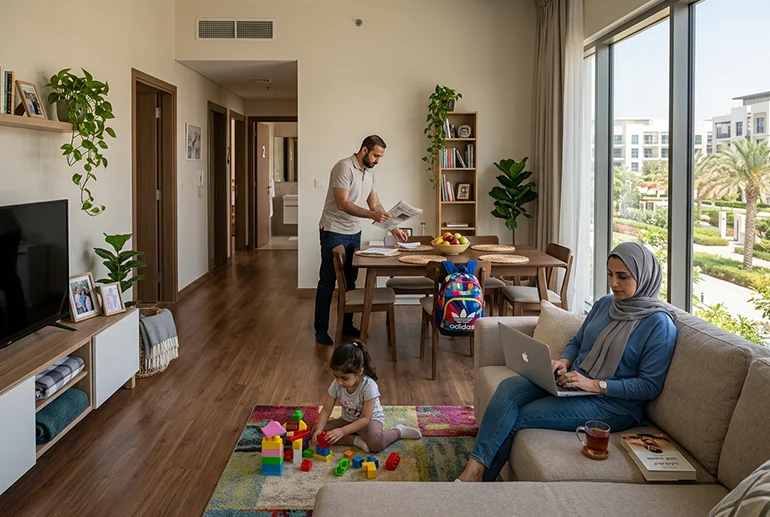
For families, the difference between the two cities becomes more tangible:
Dubai
A standard two-bedroom unit costs between AED 85,000 and AED 160,000 per year. Three-bedroom family villas or apartments in popular areas start at AED 130,000 and range up to over AED 250,000.
Abu Dhabi
Two-bedroom family apartments rent for around AED 65,000 to AED 120,000 per year, and three-bedroom units rent for AED 90,000 to AED 170,000 per year.
Central areas vs. marginal and hidden entry costs
Remember that the rent is not your only expense! When signing the contract, you will need to manage the following initial costs:
- Deposit: 5% of the annual rent for an unfurnished property and 10% for a furnished property.
- Agency Fee: Usually 5% of the annual rent (minimum 5,000 dirhams).
- Service Connection Fee (DEWA / ADDC): In Dubai, you pay about 2,100 dirhams for water and electricity connection (DEWA) and about 1,000 dirhams in Abu Dhabi (ADDC) as a deposit and setup fee.
- Housing Fee / Tawtheeq: In Dubai, 5% of the annual rent is added to the DEWA bill monthly. In Abu Dhabi, 5% of the annual rent is also calculated and received in the form of a “Tawtheeq” system.
In general, we should say that the main part of the cost of living in Dubai and Abu Dhabi includes the cost of rent, so you should pay special attention to it.
Utilities, Internet and Mobile

It is true that Dubai and Abu Dhabi are in the same country, but each emirate has its own tariff structure. In Dubai (DEWA) there is a tiered system, and as consumption increases, the cost of each unit increases, and fuel costs are also calculated separately. In Abu Dhabi (ADDC) you have a daily consumption quota, and to that extent, the price is more fixed and predictable.
| Scenario | Dubai (DEWA) | Abu Dhabi (ADDC) | Real Difference |
| 1-bedroom – Winter (average use) | 300 – 600 AED | 200 – 350 AED | ~15–25% |
| 1-bedroom – Summer (high use) | 800 – 1,200 AED | 400 – 600 AED | ~20–35% |
| 2-bedroom – Winter | 500 – 800 AED | 400 – 600 AED | ~15–20% |
| 2-bedroom – Summer | 800 – 1,500 AED | 800 – 1,200 AED | ~10–25% |
| Home Internet | 299 – 360 AED | same | No difference |
| Mobile Plans | From 50 AED+ | same | No difference |
The table above shows that, except for Utilities, Internet, and Mobile, they are almost the same.
Groceries and Dining Out

The price of a daily grocery basket in national hypermarket chains (such as Carrefour, Lulu, Viva and Spinneys) is very similar in both cities. For example, a monthly shopping basket including bread, rice, dairy, meat, fruit and vegetables for a couple usually costs around 1,200 to 1,800 dirhams.
The situation is similar when it comes to eating out. A meal in an average restaurant costs between 40 and 70 dirhams per person, while a dinner for two in a better restaurant usually costs between 200 and 350 dirhams. Dubai has more luxury options, of course, but for a simple meal, the price difference is not noticeable.
Transport and Commuting
Both Dubai and Abu Dhabi have a variety of options for getting around the city, with some differences in the public transport system!
1. Public transport

Dubai has a very modern metro system that connects the main areas of the city. You can use the metro by purchasing a Nol card and charging it monthly for between 230 and 350. In Abu Dhabi, the metro does not yet exist, and the system is based on city buses (with a Hafilat card), which are much cheaper (a monthly card costs around 80-100 dirhams), but do not have the time and speed coverage of the Dubai metro.
2. Taxi/ride-hailing

Taxis and apps like Careem and Uber are available in both cities, and prices are fairly similar; a typical city trip costs between 20 and 40 dirhams. However, at times, fares can increase by up to 20% due to the greater traffic and congestion in Dubai.
3. Owning a car
The selling price of new or used cars is the same across the UAE. However, insurance costs in Dubai can be 5-15% higher than in Abu Dhabi. This is due to the higher traffic density and higher accident rates in Dubai. Gasoline prices are the same across the UAE, so this part of the cost is the same across the UAE, so there is no difference between the two cities.
4. Monthly rental
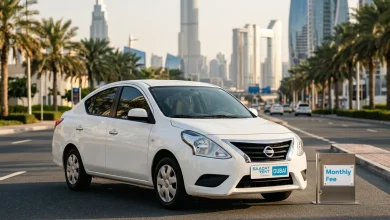
If you are planning a short stay or have not yet decided to buy a car, monthly car rental Dubai or Abu Dhabi is a logical and hassle-free option; it takes away many of the hidden costs of car ownership (insurance, maintenance, depreciation).
Cost comparison between major transportation options
Finally, the table below can provide a simple comparison between the three main transportation options, regardless of which city you live in:
| Cost Category / Method | Ownership (Nissan Kicks 2026) | Monthly Rental (Nissan Kicks 2026) | Public Transport |
| Base Monthly Cost | 1,600 – 1,900 AED (loan/depreciation) | 1,170 AED (fixed) | 100 – 350 AED |
| Insurance & Maintenance | 300 – 500 AED | Free (included) | 0 |
| Estimated Fuel Cost | 400 – 650 AED | 400 – 650 AED | 0 |
| Tolls (Salik/DARB) | 150 – 350 AED | 150 – 350 AED | 0 |
| Monthly Parking | 100 – 300 AED | 100 – 300 AED | 0 |
| Estimated Monthly Total | 2,550 – 3,700 AED | 1,820 – 2,470 AED | 100 – 350 AED |
Note: In Dubai, the Salik system is active and costs between 4 and 6 dirhams depending on rush hour. In Abu Dhabi, the Abu Dhabi DARB toll system is active on entrance bridges and main highways, with the cost of passing through its gates being 4 dirhams during peak hours.
Schools, Childcare and Healthcare

This is another area where you can clearly see the difference in cost of living in Abu Dhabi vs Dubai.
1. Schools and education
Tuition fees for premium and international schools (British, American, or Baccalaureate systems) in Dubai start at AED 30,000 and go up to over AED 90,000 for high school. On the other hand, in Abu Dhabi, costs are usually 10-20% more affordable than in Dubai.
2. Childcare and daycare
High-quality daycare centers in both emirates charge between AED 2,000 and AED 4,500 per month.
3. Healthcare and insurance
Having health insurance is mandatory in both emirates. In Abu Dhabi, the employer must also cover the basic insurance for the spouse and up to three children, but in Dubai, only the employee’s own insurance is usually required (unless otherwise agreed in the employee’s benefits package). The cost of private insurance per person per year is around AED 3,000 to 12,000.
In short, Dubai is noticeably more expensive in this area, especially in insurance costs.
Entertainment and Lifestyle

Dubai is known for its variety of activities: large malls, beaches, restaurants, and art events. A movie ticket costs around 40-60 dirhams, and a monthly gym membership costs between 200-400 dirhams. Abu Dhabi also has its own options: the Louvre Abu Dhabi, Yas Island with its theme parks, and the Corniche, which is free and always accessible. Both cities have plenty of free activities too, so fun doesn’t necessarily mean expensive; it just depends on your taste and which type of activity you enjoy the most.
Salary Needed in Dubai vs Abu Dhabi
Instead of telling you “you should earn a certain amount”, we’d like to give you a simple formula for your own calculation: Rent + Fixed costs (utilities, internet, transport) + Variable costs (shopping, food, entertainment) + School fees (if there are children) = Minimum monthly salary required.
- For a couple without children living in a two-bedroom apartment in a relatively central area, this formula in Dubai usually comes to between AED 18,000 and AED 25,000 per month; in Abu Dhabi, the same scenario is usually between AED 15,000 and AED 21,000.
- For a family of four with one child in an international school, this figure could be between AED 35,000 and AED 50,000 in Dubai and AED 30,000 and AED 42,000 in Abu Dhabi.
These are just sample scenarios for the cost of living in Dubai vs Abu Dhabi comparison; Be sure to replace this formula with real-life numbers from your own life.
Which City Is Better for You?
To better summarize, the table below will help you see which city best suits your situation:
| Persona / Situation | Recommended City | Main Reason |
|---|---|---|
| Single professional seeking networking | Dubai | More jobs, networking, and nightlife |
| Family with young or school-age children | Abu Dhabi | Calmer, safer, and more affordable housing |
| Freelancer/Remote worker | Abu Dhabi | Lower fixed living costs |
| Frequent traveller | Dubai | Better access to DXB and global flights |
| Working in Dubai | Dubai | Avoid long intercity commutes |
| Working in Abu Dhabi | Abu Dhabi | Residency may be required for some benefits |
Can You Live in One City and Work in the Other?
You might think that living in Abu Dhabi (cheaper) and working in Dubai would be the best option, but you also need to consider the reality of the commute and the Dubai to Abu Dhabi distance. A typical round trip takes about 3 hours and can take up to 4 hours in traffic. In addition to time, fuel costs, tolls, car depreciation, and most importantly, daily fatigue will affect your quality of life. It’s best to try this route during peak traffic hours before making a final decision to get a more realistic view.
Ready to explore the UAE? Start with the right car.
Choose your car, set your dates and pick your preferred delivery location.
Find Your Rental Car →wrap up
To sum up this long story in a few sentences: Abu Dhabi is generally a cheaper option, especially for families and those looking for peace and quiet; Dubai, on the other hand, is more expensive but offers better public transport infrastructure, a wider range of lifestyle options, and more job opportunities. Neither city is “better”; the right choice depends entirely on your personal preferences, work location, and lifestyle.
FAQ
Is Abu Dhabi cheaper than Dubai?
Yes, Abu Dhabi is generally cheaper, mainly due to lower rent. For singles and couples, the difference is around 15-20%, and for families, when school fees are included, it drops to 10-15%.
Which city has cheaper rent?
Abu Dhabi. For a similar unit, rent in Abu Dhabi is typically 20-30% lower than in Dubai, although this varies depending on the area and type of unit.
How much does a single person need per month?
Including renting a decent apartment, a single person in Dubai will typically need between AED 9,000 and AED 14,000 per month, and in Abu Dhabi between AED 7,500 and AED 11,500 per month.
Which city is better for families?
Abu Dhabi is generally a more popular choice for families due to its quieter, lower-cost, and more family-friendly environment, although Dubai also has some great family options like Arabian Ranches and Dubai Hills.
Is commuting between the two cities realistic and practical?
For some, yes, but you should take into account peak-hour traffic. Travel times can range from 90 minutes in normal conditions to two hours or more during rush hour, so be sure to test the route during those times before making a decision.
Is public transportation cheaper?
Yes, in both Dubai and Abu Dhabi, public transport is much cheaper than owning a car or taking a taxi every day; a monthly metro pass in Dubai usually costs less than 350 dirhams.
Which city has higher salaries?
Dubai generally has more high-paying job opportunities due to its larger job market and variety of industries, but because the cost of living is also higher, the actual salary (after deducting expenses) is not necessarily higher than in Abu Dhabi.