
- Dubai Cost of Living: Quick Monthly Summary
- Monthly Budget by Household Type
- Housing and Rent Costs in Dubai
- Utilities, Internet and Mobile Costs
- Grocery and Dining Costs in Dubai
- Transportation Costs in Dubai
- Healthcare and Insurance Costs
- Education and Childcare Costs
- Entertainment and Lifestyle Costs
- One-Time Moving and Setup Costs in Dubai
- Is Dubai Expensive Compared to Other Cities?
- Ways to Reduce Living Costs in Dubai
- FAQ About the Cost of Living in Dubai
Last updated: August 2026
If you’re looking for an accurate and up-to-date answer to the cost of living in Dubai, you should know that this number is not fixed. The cost of living in Dubai depends heavily on your lifestyle, area of residence, family size, and whether your children attend a private school. A single person living in an apartment outside the city center is in a completely different financial situation from a family of four with two school-age children and a private car.
In this guide, we provide a realistic budget for a single person, couple, family of 3, and family of 4, based on data from Numbeo, DMCC, Property Finder, and official sources such as DEWA, RTA, and KHDA. We have also divided the costs into two categories: monthly expenses, such as rent, food, and transportation, and one-time setup costs, such as rental deposits and agency fees.
The goal is to help you understand the Dubai cost of living, compare different household budgets, and set a realistic budget before moving to Dubai.
Dubai Cost of Living: Quick Monthly Summary

A quick look at the average cost of living in Dubai shows that monthly expenses vary significantly depending on household size and whether rent is included.
According to Numbeo data updated in August 2026, monthly expenses excluding rent are around AED 4,150 for a single person and around AED 14,560 for a family of four.
| Household | Without Rent (AED/month) | With Rent (AED/month) | Explanation |
| Single | 4,000–6,500 | 9,500–15,000 | Numbeo average + 1-bedroom apartment rent |
| Couple | 6,500–10,500 | 13,000–21,000 | Planning estimate based on two-person expenses + 1- or 2-bedroom rent |
| Family of 3 | 9,500–13,500 | 17,000–26,000 | Planning estimate based on household size and typical 2-bedroom housing |
| Family of 4 | 13,000–20,000 | 24,000–37,000 | Numbeo average + 3-bedroom apartment rent |
For someone trying to keep living expenses in Dubai low, a single person may manage everyday expenses at around AED 4,000–4,500 per month without rent. However, this leaves limited room for unexpected expenses.
Monthly Budget by Household Type
The Dubai average cost of living changes considerably depending on the number of people in the household.
Single Person
A single person can expect to spend approximately AED 4,000–6,500 per month excluding rent, depending on food, transportation, entertainment, and lifestyle choices. Adding a 1-bedroom apartment can bring the total to approximately AED 9,500–15,000 per month.
Couple
A couple may need approximately AED 6,500–10,500 per month excluding rent. With a 1- or 2-bedroom apartment, the total monthly budget can reach approximately AED 13,000–21,000.
Family of 3
The cost of living in Dubai for a family of 3 can be approximately AED 9,500–13,500 per month excluding rent, with a total budget of around AED 17,000–26,000 including rent. This is a planning estimate rather than a published average and can increase significantly if the child attends private school or requires childcare.
Family of 4
The cost of living in Dubai for a family of 4 is approximately AED 13,000–20,000 per month excluding rent based on household spending estimates. With a 3-bedroom apartment, the total can reach approximately AED 24,000–37,000 per month, before higher-end schooling and lifestyle expenses.
Housing and Rent Costs in Dubai
Rent is usually the largest component of the cost of living in Dubai. A common budgeting rule is to keep housing around 30–40% of monthly income, although the actual percentage varies considerably by household and location.
Affordable Areas
Areas such as:
- JVC (Jumeirah Village Circle)
- Al Nahda
- Deira
- International City
can be suitable for residents looking for more affordable housing options.
Mid-Range Areas
Areas such as:
- JLT (Jumeirah Lakes Towers)
- Al Barsha
- Dubai Sports City
can offer a balance between housing costs, access to public transport, and quality of life.
According to DMCC, a one-bedroom apartment in JLT can range from around AED 50,000 to AED 100,000 per year, depending on the size and property. The figures reflect Numbeo-based data referenced by DMCC in January 2026.
Premium Areas
Premium areas include:
- Downtown Dubai
- Dubai Marina
- Palm Jumeirah
- Emirates Hills
According to Numbeo data updated in August 2026, the average monthly rent for a one-bedroom apartment is approximately AED 5,475 outside the city center and AED 9,095 in the city center.
| Apartment Type | Approximate Annual Rent (AED) | Monthly Equivalent (AED) |
| 1 Bedroom, Outside City Center | 65,700 | 5,475 |
| 1 Bedroom, City Center | 109,140 | 9,095 |
| 3 Bedroom, Outside City Center | 130,160 | 10,847 |
| 3 Bedroom, City Center | 201,857 | 16,821 |
I expected food to be my biggest expense, but housing and transportation cost me more. If you’re moving to Dubai, consider your daily commute before choosing a cheaper home.
Price Alert: Rent can change quickly by area, season, and demand. Check current listings before renting.
Utilities, Internet and Mobile Costs

Dubai utility bills can vary significantly depending on apartment size and electricity, water, and cooling consumption.
Electricity, Water and Cooling
DEWA uses a progressive tariff structure for electricity and water. For residential consumers, the electricity tariff ranges from AED 0.23 to AED 0.38 per kWh, depending on monthly consumption. Water is also charged using a progressive tariff structure. DEWA’s current tariff information also includes a fuel surcharge and 5% VAT.
For budgeting purposes, Numbeo’s August 2026 data puts the average cost of basic utilities for a typical apartment at around AED 895 per month, with actual costs varying according to apartment size and consumption.
Air conditioning can also make a noticeable difference to your monthly bill, particularly during Dubai’s hottest months.
Internet Costs
Home internet with unlimited data and a minimum speed of around 60 Mbps costs approximately AED 338 per month, according to Numbeo data updated in August 2026.
Mobile Phone Costs
A mobile package with calls and more than 10 GB of data costs around AED 204 per month, based on Numbeo data updated in August 2026.
Grocery and Dining Costs in Dubai

Grocery prices are an important part of living expenses in Dubai and depend largely on your shopping habits and how often you eat at restaurants.
Common Grocery Prices
According to Numbeo data updated in August 2026:
| Grocery Item | Approximate Price (AED) |
| Milk, 1 liter | 6.6 |
| Eggs, 12 | 12.3 |
| Chicken breast, 0.5 kg | 14.8 |
| Beef, 0.5 kg | 21.3 |
| Regular bread | 4.9 |
Dining Out
Typical restaurant prices include:
- Budget restaurant meal: around AED 46 per person
- Mid-range dinner for two: around AED 300
- Fast-food meal: around AED 35
A single person who cooks most meals at home can generally budget around AED 800–1,500 per month for groceries. People who eat out regularly may spend AED 2,000–3,500 or more on food.
For a family of four, monthly groceries can be around AED 2,500–4,500, depending on shopping habits, imported products, and how often the family eats outside the home.
Transportation Costs in Dubai
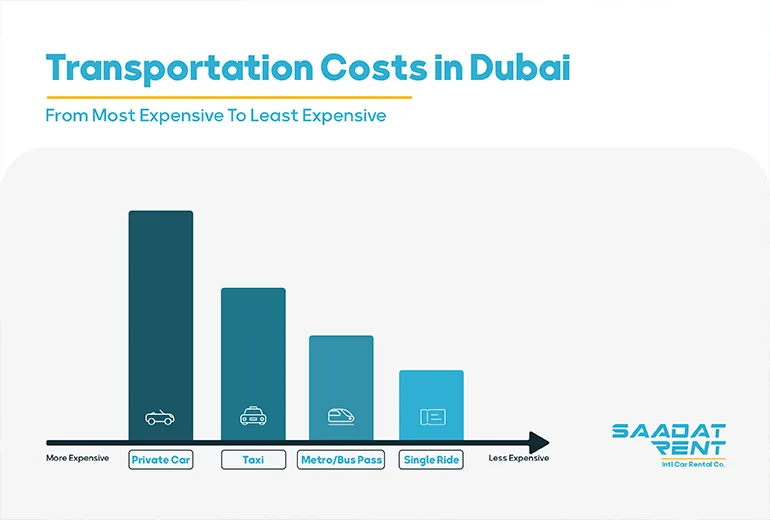
Transportation is an important part of the cost of living Dubai, especially if your home and workplace are far apart.
Public Transport
Dubai’s metro and bus network can be the most affordable option for people who live and work close to public transport stations.
According to RTA’s current Nol fare information:
| Public Transport Option | Fare |
| Silver Card, 1 zone | AED 3 |
| Silver Card, 2 adjacent zones | AED 5 |
| Silver Card, more than 2 zones | AED 7.50 |
| 30-day pass, 1 zone | AED 140 |
| 30-day pass, 2 zones | AED 230 |
| 30-day pass, all zones | AED 350 |
Taxi
Taxi fares vary according to the journey and booking method. For budgeting purposes, Numbeo’s August 2026 data can be used as a general estimate, but taxi fares should not be treated as a fixed monthly cost.
Fuel
Fuel prices change monthly, so the latest official UAE fuel price should be checked before calculating a long-term driving budget. The exact monthly fuel price should not be treated as a fixed annual figure.
Car Rental
Economy car rental Dubai prices vary according to the vehicle, rental period, insurance package, season, and rental company. Rather than presenting AED 900–1,100 as a universal market price, compare current rental offers for the exact period and vehicle you need.
For people looking for a budget-friendly option, a Toyota Yaris rental Dubai can provide a balance between fuel efficiency, comfort, and city driving.
Car Ownership
Buying a car involves more than the purchase price. You should also budget for:
- Insurance
- Fuel
- Parking
- Maintenance
- Registration
- Depreciation
For long-term residents who drive heavily every day, ownership may become more economical than renting, but the calculation depends on the vehicle and length of stay.
Is Renting a Car Worth It in Dubai?
For short stays, frequent trips between different parts of Dubai, or living in areas without convenient metro access, car rental in Dubai can make more sense than buying.
A rental car can be particularly useful when:
- You need flexibility for daily trips.
- You travel between Dubai and other emirates.
- Your workplace or school is far from a metro station.
- You want to avoid the upfront cost of buying a vehicle.
For longer stays with heavy daily driving, buying a car can become more economical in the long run.
Salik Costs
Salik toll charges vary according to the applicable time and current pricing structure. Because these rates can change, check the latest official Salik rates when calculating your driving budget rather than using a fixed AED 4–6 estimate.
Transportation Decision Table
| Option | Best For | When It Makes Sense | Main Advantage | Main Drawback |
| Metro/Bus | Daily commuters | Near metro stations | Affordable | Limited coverage |
| Taxi | Occasional trips | When convenience matters | Flexible | Costly for daily use |
| Car Rental | Short-term stays | Need flexibility | No ownership costs | Fuel and parking |
| Car Ownership | Long-term residents | Frequent daily driving | Convenient | Insurance and maintenance |
For more information, see our Dubai public transport guide, which can help you gain more information about prices.
Healthcare and Insurance Costs

Health insurance is an important part of the cost of living in Dubai, and residents should budget for the level of coverage they need.
Insurance prices vary significantly according to age, coverage, medical history, insurer, and whether the policy is individual or family-based.
Typical planning ranges include:
- Basic insurance: around AED 500–800 per year for basic low-cost coverage
- Mid-range insurance: around AED 3,000–7,000 per year
- Comprehensive insurance: around AED 8,000–20,000+ per year
These figures are planning ranges rather than official fixed prices. Always compare current insurance quotations before purchasing a policy.
Doctor consultations without insurance can also vary significantly by clinic and specialty, with a general planning range of around AED 200–700+ per visit.

Education and Childcare Costs

School fees can become one of the largest components of the cost of living in Dubai for family of 4, especially when two or more children attend private schools.
Private school fees vary widely according to curriculum, school, grade, and location.
| School Type | Annual Fee (AED) | Monthly Equivalent (AED)* |
| Indian/Budget Schools | 9,000–25,000 | 750–2,080 |
| Mid-Range Schools | 35,000–90,000 | 2,900–7,500 |
| Premium/IB International Schools | 90,000–130,000+ | 7,500–10,800+ |
Monthly equivalents are calculated for budgeting purposes only and do not necessarily reflect how schools collect fees.
Importantly, KHDA confirmed on 22 May 2026 that private school fees in Dubai would be frozen for the 2026–27 academic year, meaning there would be no fee increase for that academic year. (KHDA)
Additional education costs
Additional education costs may include:
- Registration fees
- School transport
- Uniforms
- Books
- School activities
- Meals
For childcare, Numbeo’s August 2026 data puts the average cost of private full-time daycare at around AED 3,083 per month, with a range of approximately AED 2,000–5,000 depending on the center and location.
I once chose a cheaper home farther from a child’s school to reduce rent. After adding transportation costs and commute time, the savings were much smaller than expected. If you have children, consider both rent and school location before choosing a home.
Planning to live or work in Dubai?
Stop overpaying for transport!
reserve your cheap car rental in dubai before prices increase →Entertainment and Lifestyle Costs
Entertainment is one of the most flexible parts of the Dubai cost of living.
According to Numbeo data updated in August 2026:
| Activity | Approximate Cost |
| Gym membership | AED 337/month |
| Cinema ticket | AED 60 |
| Tennis court, one hour | AED 174 |
You can reduce this part of your budget by taking advantage of free beaches, parks, walking areas, and free community events.
One-Time Moving and Setup Costs in Dubai
Moving to Dubai requires some upfront expenses that should not be confused with monthly living expenses in Dubai.
| Cost | Amount (AED) | Type |
| Security Deposit | ~5% of annual rent | Refundable |
| Agent Fee | ~5% of annual rent + VAT | Non-refundable |
| Ejari | 178–220 | Registration |
| DEWA Deposit | 2,000 apartment / 4,000 villa | Refundable |
| DEWA Activation | ~130 | One-time |
| Chiller Deposit | 1,000–6,000 | Varies by provider |
Price Fluctuation Alert: Rental-related deposits and fees can change according to property prices and the terms of your tenancy contract. Always confirm the exact amount before signing.
Is Dubai Expensive Compared to Other Cities?
Dubai is generally considered an expensive city, but whether it feels expensive depends heavily on your salary, housing choice, and lifestyle.
For a like-for-like comparison, Numbeo can be used to compare Dubai with other major cities using the same cost categories and methodology.
According to Numbeo’s August 2026 comparisons:
- London has higher overall living costs than Dubai, particularly when rent is included.
- New York also has higher overall living costs than Dubai, especially when housing is included.
Dubai’s lack of personal income tax can increase take-home pay compared with cities where employment income is taxed. However, actual purchasing power still depends on salary, housing costs, schooling, transportation, and lifestyle.
Ways to Reduce Living Costs in Dubai
You can reduce your Dubai living cost by making a few practical choices:
- Choose more affordable neighborhoods such as JVC or Al Nahda instead of Downtown or Marina.
- Share accommodation to reduce rent per person.
- Cook at home instead of eating out frequently.
- Use the metro and bus for regular commuting when practical.
- Compare several health insurance plans before choosing one.
- Control air-conditioning use to reduce utility bills.
- Choose housing close to your workplace or children’s school.
- For short-term stays, compare car rental costs with the cost of taxis and car ownership.
Want to reduce your monthly expenses in Dubai?
Choosing the right transportation option can save you hundreds of dirhams every month.
see all Budget-Friendly Car Rental Options →FAQ About the Cost of Living in Dubai
What is the average cost of living in Dubai?
According to Numbeo data updated in August 2026, the average cost of living in Dubai for a single person, excluding rent, is around AED 4,150 per month. Adding a one-bedroom apartment outside the city center can bring the total to around AED 9,500–10,000 per month.
What salary do you need to live in Dubai?
For a single person, a monthly salary of around AED 12,000–17,000 can provide a comfortable lifestyle depending on rent and spending habits. For a family of four with private school fees, the required household income can reach AED 25,000–35,000+ per month.
What is the cost of living in Dubai for a family of 4?
The cost of living in Dubai for a family of 4 is approximately AED 13,000–20,000 per month excluding rent, based on Numbeo and household budgeting estimates. Adding a three-bedroom apartment can bring the total to around AED 24,000–37,000 per month, before higher-end schooling and lifestyle expenses.
What is the cost of living in Dubai for a family of 3?
The cost of living in Dubai for a family of 3 can be around AED 9,500–13,500 per month excluding rent. This is a planning estimate rather than a published average for this exact household size. Adding a typical two-bedroom apartment can bring the total to approximately AED 17,000–26,000 per month.
Can you live in Dubai on AED 5,000?
For a single person, AED 5,000 per month excluding rent can be feasible with a careful budget, but it leaves little room for unexpected expenses. If rent is also included, living on AED 5,000 is generally difficult unless you use shared accommodation.
How much should rent be as a percentage of income?
A common budgeting rule is to keep rent at around 30–40% of monthly income. Because Dubai rental contracts are often paid through annual or quarterly cheques, calculate this percentage using the monthly equivalent of your annual rent.
Do you need a car to live comfortably in Dubai?
Not necessarily. If you live and work in areas such as Downtown Dubai, JLT, Dubai Marina, or DIFC, public transport may be enough for daily commuting. If your workplace, home, or children’s school is far from metro and bus routes, renting or owning a car can provide much greater convenience.
Is Dubai expensive compared with London?
Yes, London generally has higher living costs than Dubai when comparing the same cost categories. However, the difference depends on whether rent is included and on your lifestyle. Dubai’s lack of personal income tax can also affect the amount of salary you take home.